Thursday, December 26, 2013

The Upper Room (Cenacle) - Jerusalem

The Room of the Last Supper called the Coenaculum, or the Cenacle, or the Upper Room, lies just outside the Dormition Abbey behind the Franciscan house on Sion. The Tomb of King David is believed to be located beneath the Upper Room.
 
The Upper Room brings to mind the scene of momentous events recounted in the Gospels: the institution of the Eucharist during the Last Supper, Jesus' appearance before the Apostles after his Resurrection and the descent of the Holy Spirit over the Apostles at Pentecost.
 
The descent of the Holy Spirit over the Apostles at Pentecost, is commemorated in the Chapel of the Descent of the Holy Spirit, exactly above the room where King David's Tomb is venerated.
 
Upon entering the Upper Room you find yourself in a large hall. The ceiling is supported by three pillars which divide the room into three naves. The pillars and the arches, windows and other Gothic style architectural elements are a clear indication the room was built by the Crusaders in the early 14th century, on top of a much older structure most probably pre-dating the first churches erected in Palestine. This old structure, according to the archaeological research, was a church-synagogue of the early Christian community of Jerusalem.
 
 
The Crusader Church where the Upper Room is located


Stairs to the Upper Room


The Upper Room

The Upper Room


Pater Noster Church - Jerusalem

While in Jerusalem, we visited the Pater Noster Church, which is named after the "Our Father" prayer (Pater Noster is "Our Father" in Latin). This church was built on the traditional site in Jerusalem where Jesus taught His disciples the Lord's Prayer. Emperor Constantine built a church over a cave here in the 4th century, and since then, it has been partially reconstructed. Plaques in the cloister bear the Lord's Prayer in 62 different languages.


Beautiful church courtyard


One wall of translations of the "Our Father"


The "Our Father" in Aramaic (the language Jesus spoke)
and in Hebrew.


The "Our Father" in French.


Friday, November 29, 2013

Masada

On November 10, we visited Masada along the Dead Sea.

Masada (Hebrew for fortress) was the last Jewish stronghold against the Roman invasion in the early 70s A.D. Next to Jerusalem, it is the most popular destination of tourists visiting Israel.

Masada is located atop an isolated rock cliff at the western end of the Judean Desert overlooking the Dead Sea. The natural approaches to the cliff top are very difficult. We took a cable car all the way to the top!


Dead Sea with the mountains of Jordan on the other side. Note the white "trim" around the banks of the Dead Sea? Salt!

 
On the other side of the Masada fortress . . . desert!


The only written source about Masada is Josephus Flavius’ The Jewish War. Born Joseph ben Matityahu into a priestly family, he called himself Josephus Flavius and became a Roman citizen and a successful historian.
 
According to Flavius, Herod the Great built the fortress of Masada between 37 and 31 BCE. Herod, an Idumean, had been made King of Judea by his Roman overlords and “furnished this fortress as a refuge for himself.” It included a casemate wall around the plateau, storehouses, large cisterns ingeniously filled with rainwater, barracks, palaces and an armory.


Large cistern for collecting rain water.


Part of Herod's large bathhouse. Below is the double floor of the hypocaust, through which the hot room (caldarium) was heated.


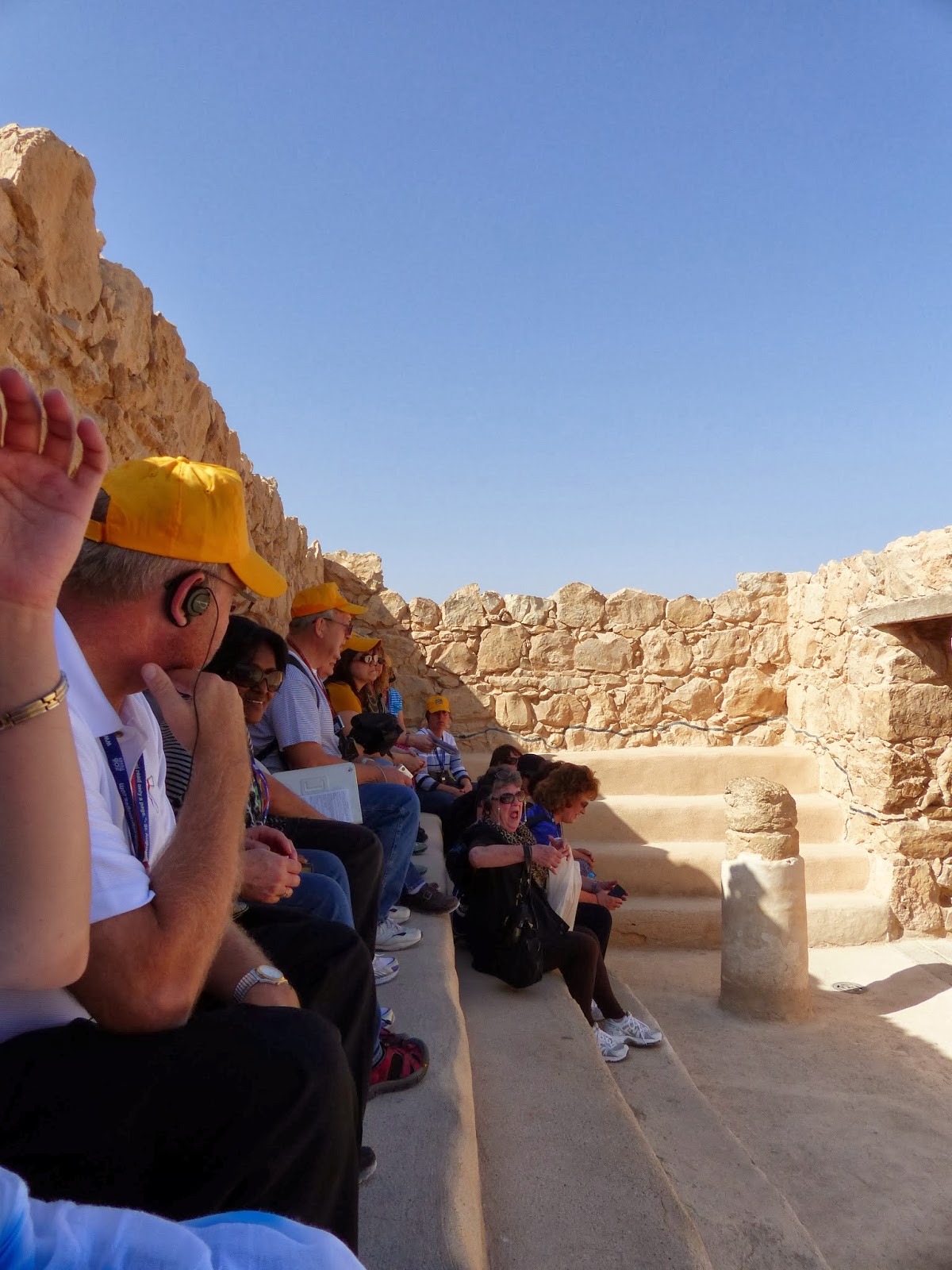
Ancient synagogue.


Catholic pilgrims take a break sitting in the shade of the synagogue.


The ground floor of the columbarium tower below served as a dovecot, a structure intended to house pigeons or doves. Notice the niches in the walls? This is where the doves would roost. The doves supplied meat for the inhabitants of Masada and fertilizer for the agricultural crops.


Large stones manufactured by the Jewish rebels (or Zealots) to be rolled down the hill upon the Romans troops.


Some 75 years after Herod’s death, at the beginning of the Revolt of the Jews against the Romans in 66 CE, a group of Jewish rebels overcame the Roman garrison of Masada. After the fall of Jerusalem and the destruction of the Temple (70 CE) they were joined by zealots and their families who had fled from Jerusalem. There, they held out for three years, raiding and harassing the Romans.
 
Then, in 73 CE, Roman governor Flavius Silva marched against Masada with the Tenth Legion, auxiliary units and thousands of Jewish prisoners-of-war. The Romans constructed a rampart of thousands of tons of stones and beaten earth against the western approaches of the fortress and, in the spring of 74 CE, moved a battering ram up the ramp and breached the wall of the fortress.
 
Once it became apparent that the Tenth Legion's battering rams and catapults would succeed in breaching Masada's walls, Elazar ben Yair - the Zealots’ leader - decided that all the Jewish defenders should commit suicide; the alternative facing the fortress’s defenders were hardly more attractive than death.
 
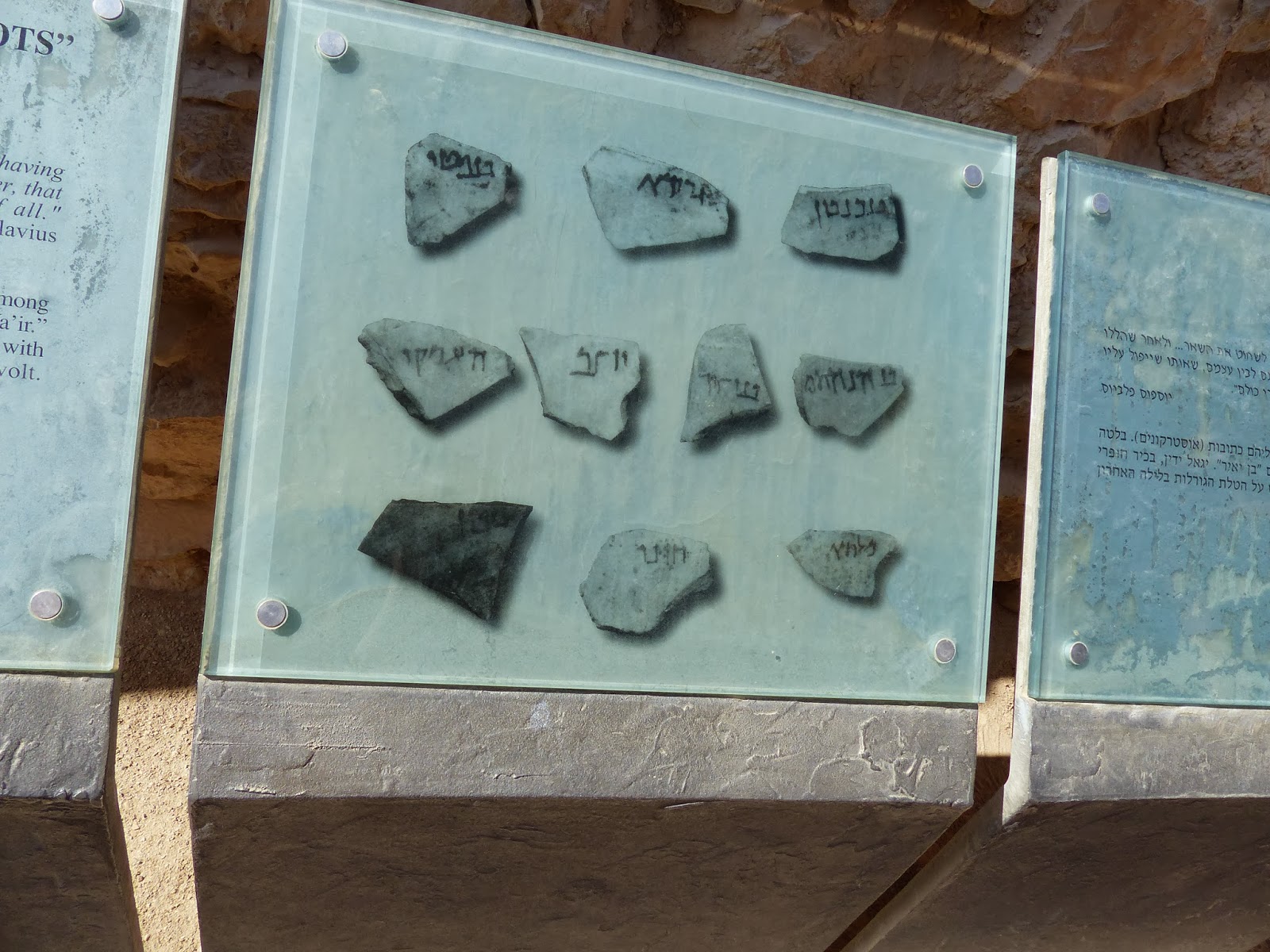
Flavius dramatically recounts the story told him by two surviving women. The defenders – almost one thousand men, women and children – led by ben Yair, burnt down the fortress and killed each other. The Zealots cast lots to choose 10 men to kill the remainder. They then chose among themselves the one man who would kill the survivors. That last Jew then killed himself.
 
Pottery shards with Jewish names on them -- most likely the lots that individuals cast to decide who would kill the others in the Masada fortress.


Saturday, November 23, 2013

Food in Israel

Many people have asked me about the food in Israel, so I thought some photos would give you a good idea of what we ate. The food was very good -- lots of salads, hummus, all kinds of meats, especially lamb (which I loved), pita bread, etc. All fresh and very tasty!

Dinner on our first night in Tel Aviv.


Lunch in Bethlehem.

 
Our food was not only yummy, but it was also colorful!


Julie was a little thirsty after our busy morning! Ha! Note the oversized Coke can!


The Hooded Crow in Israel

I couldn't resist blogging about this -- when we descended from the Church of the Visitation and were waiting for our bus, we saw some unique birds walking around on the cement. We found out that they are "hooded crows," typical in Europe, Asia, and the Middle East.

Except for the head, throat, wings, tail and thigh feathers, which are black and mostly glossy, the hooded crow's plumage is ash-grey, the dark shafts giving it a streaky appearance. The bill and legs are black; the iris dark brown.


Ein Karem - Church of the Visitation

The Franciscan Church of the Visitation in the village of Ein Karem on the west side of Jerusalem, is named after the Virgin Mary's visit to the summer house of the parents of John the Baptist. Ein Karem, according to tradition, is the birthplace of John the Baptist.
 
The Virgin Mary’s visit to Elizabeth was first set in a place other than that of the birth of Saint John at the beginning of the 14th century: "Zechariah’s house is in the mountains of Judea.. In this place there are two churches… and between these churches flows a spring that is quite full of water. At the site of the first church, it is said, Elisabeth was greeted by the Blessed Virgin Mary. It is also said that the blessed John the Baptist was hidden there during the Slaughter of the Innocents. At the site of the second church, the blessed John the Baptist was born" (Brother Giovanni Fedanzola of Perugia, 1330).


The mosaic on the face of the church illustrates the visit of Mary. She is shown riding a donkey; in the background is the village of Nazareth, her home town, and the place of her visit ("Ain Karim"). The verse in Latin is from Luke 1:39: "And Mary arose in those days, and went into the hill country with haste, into a city of Judah." The city of Judah is, according to the tradition, located in Ein Karem.


From the church, on the right side of the altar, is a tunnel that leads to an ancient well, seen below. From this well, as per the tradition, John and his parents drank from the water. In another corner is the spot where - according to tradition - John hid from the Romans behind a rock.
 
Another scene shows the Roman soldiers persecuting the mothers and killing their children in Bethlehem.  This is according to Matthew 2: 16: Then Herod, when he saw that he was mocked of the wise men, was exceeding wroth, and sent forth, and slew all the children that were in Bethlehem, and in all the coasts thereof, from two years old and under, according to the time which he had diligently enquired of the wise men."
 
Notice the angel on the left shielding Elizabeth and her son John the Baptist behind a rock.


One of the altars in the church.


Beautiful fresco of Mary and the Child Jesus with the moon under her feet . . . reminds me of Revelation 12.


Another altar with an amazingly beautiful backdrop!


Close-up of the ornate altar at the bottom of the previous photo.


Beautiful mosaic of the Virgin Mary and Jesus.


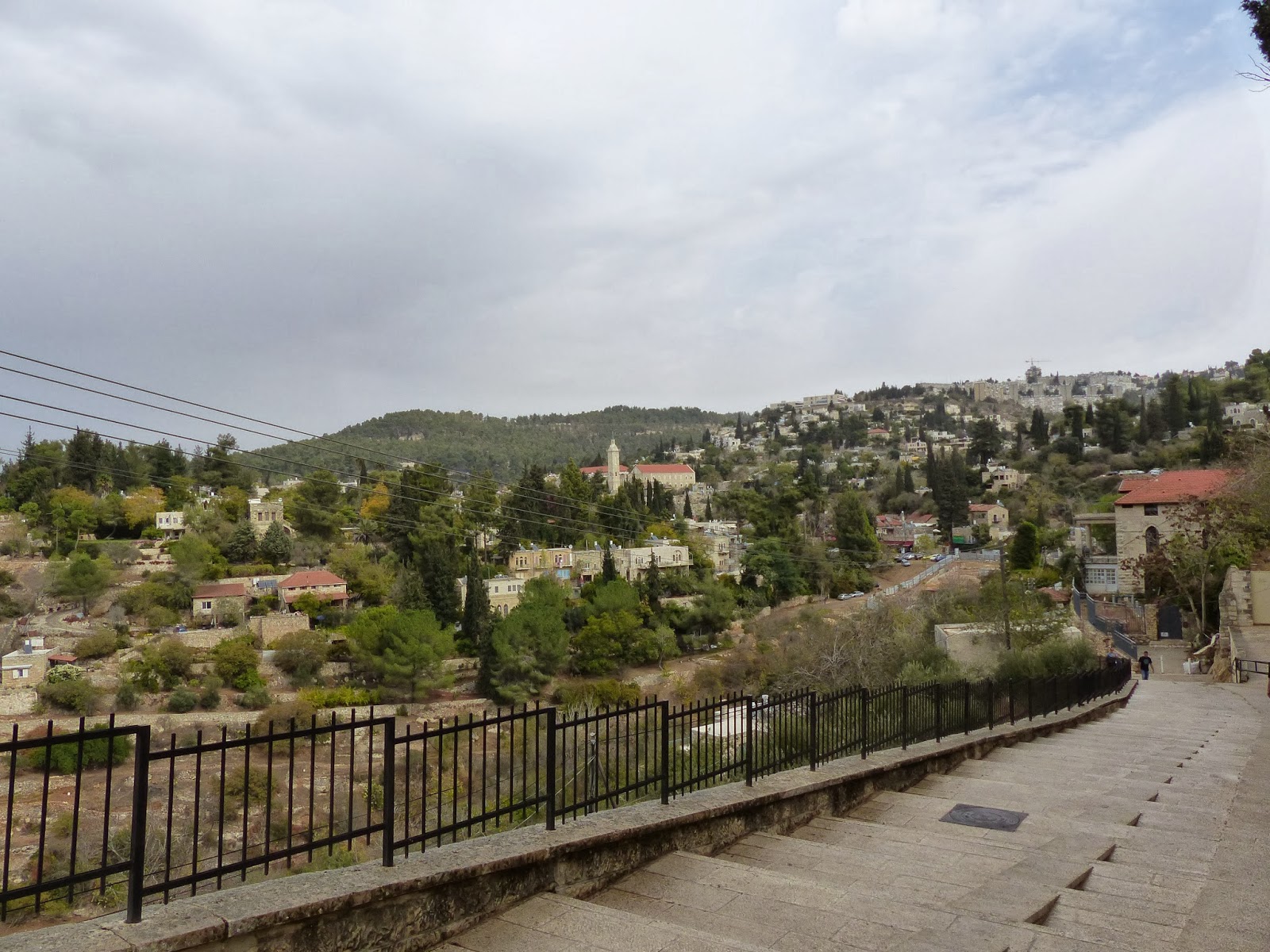
Kim at the top of the hill/mountain where the Church of the Visitation is located. Note the beautiful scenery below.

 
Norma and her four kids, Kathi, Vicki, Bill, and Pam -- what a great time they had together on this trip!


Ah yes . . . we did have to make our way back down the hill! It was quite a hike both ways!


Ein Karem - Mary's Spring

More from Ein Karem, Israel . . .

Between the Church of St. John the Baptist and the Church of the Visitation, there is a spring called the "Virgin Spring" or "Mary's Spring" by the pilgrims of the fourteenth century.

According to tradition, it was here that Mary met her cousin Elizabeth and sang a hymn of praise (the Magnificat), a song of gratitude to God.